Cold weather can cut EV range by up to 40%

A Winter Reality the Global EV Market Often Overlooks
Across Canada, it has become increasingly clear that electric vehicles behave differently in winter conditions than in the controlled environments where most global EV models are developed and tested. Range estimates that appear reliable in mild temperatures can shift significantly once temperatures fall below freezing, creating a noticeable gap between expected and actual performance.
This discrepancy is not the result of misuse or malfunction. It reflects a broader industry pattern: many EVs were simply not engineered with harsh northern climates in mind. As Canada continues moving toward widespread electrification, understanding this performance gap becomes essential.
Why Cold Weather Reduces EV Range
Lower temperatures influence electric vehicles in several interconnected ways. While none of these effects are new to battery science, their combined impact becomes especially prominent during Canadian winters.

Key factors include:
- Slower battery chemistry, which reduces available energy.
- Increased heating demand, since the cabin heater draws power directly from the battery.
- Reduced regenerative braking, particularly in icy or low-traction conditions.
- Slower charging speeds, as cold batteries accept energy less efficiently.
When these factors interact, real-world range can decrease by as much as 40%, as reported by organizations such as CAA and Recurrent Auto. These findings highlight a clear challenge for EV adoption in colder regions.
A National Transition That Requires Winter-Ready Solutions
Canada’s 2035 zero-emission vehicle mandate sets an ambitious direction, but winter performance remains a barrier for consumers considering the switch. Inconsistent range, longer charging times, and uncertainty around cold-weather reliability all influence public perception and purchasing decisions.
For a country where winter conditions define much of the driving environment, solutions must be tailored rather than adapted. EVs optimized for moderate climates cannot simply be “imported” into the Canadian market without accounting for seasonal performance shifts.
Introducing Project Arrow: An EV Concept Designed for the North
Project Arrow represents a significant step toward addressing this gap. Rather than modifying an existing platform, the initiative approaches EV design from a Canadian perspective, considering climate, geography, and supply-chain realities from the outset.
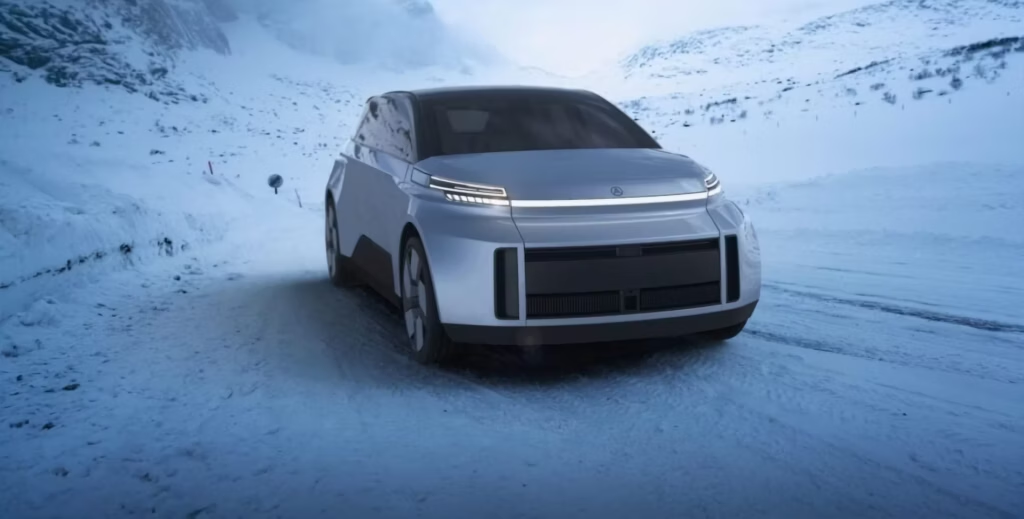
Its development emphasizes:
- thermal management designed for severe cold,
- materials suited to temperature fluctuations,
- software that allocates energy efficiently in winter conditions,
- and a parts ecosystem that supports domestic resilience.
Although Arrow is not a commercial vehicle, it demonstrates what a purpose-built Canadian EV platform can look like. It signals that winter performance does not need to be a limitation—only a design parameter.
What This Means for Consumers and the Canadian EV Landscape
As the national market evolves, drivers are increasingly looking for predictability. Reliable range estimates, consistent winter performance, and reduced dependence on ideal-weather assumptions are central to building long-term confidence in EV technology.
Project Arrow illustrates that these expectations are entirely achievable. By prioritizing cold-weather capability, the platform reframes winter from an obstacle into a design opportunity.
A Path Toward a Winter-Ready EV Future
Canada’s transition to electric mobility will depend not only on policy and infrastructure but also on the suitability of the vehicles themselves. Winter is not a niche scenario in this country—it is a defining feature of daily life for millions.
If future EVs are to serve Canadians effectively, they must be engineered with Canadian realities in mind. Project Arrow offers a foundation for that direction, demonstrating how climate-specific design can support the country’s long-term electrification goals.
See how climate-focused design can support Canada’s transition to a fully electric future.